Biome · cartography

Calces The Laboratory

Film · three reels · Locarno · p. 04

A world created to explore how civilizations emerge, evolve and reconnect with the living.

The matrix from which the Oneiro universe unfolds.

Introducing the Land of Oneiro

MAP OF ONEIRO

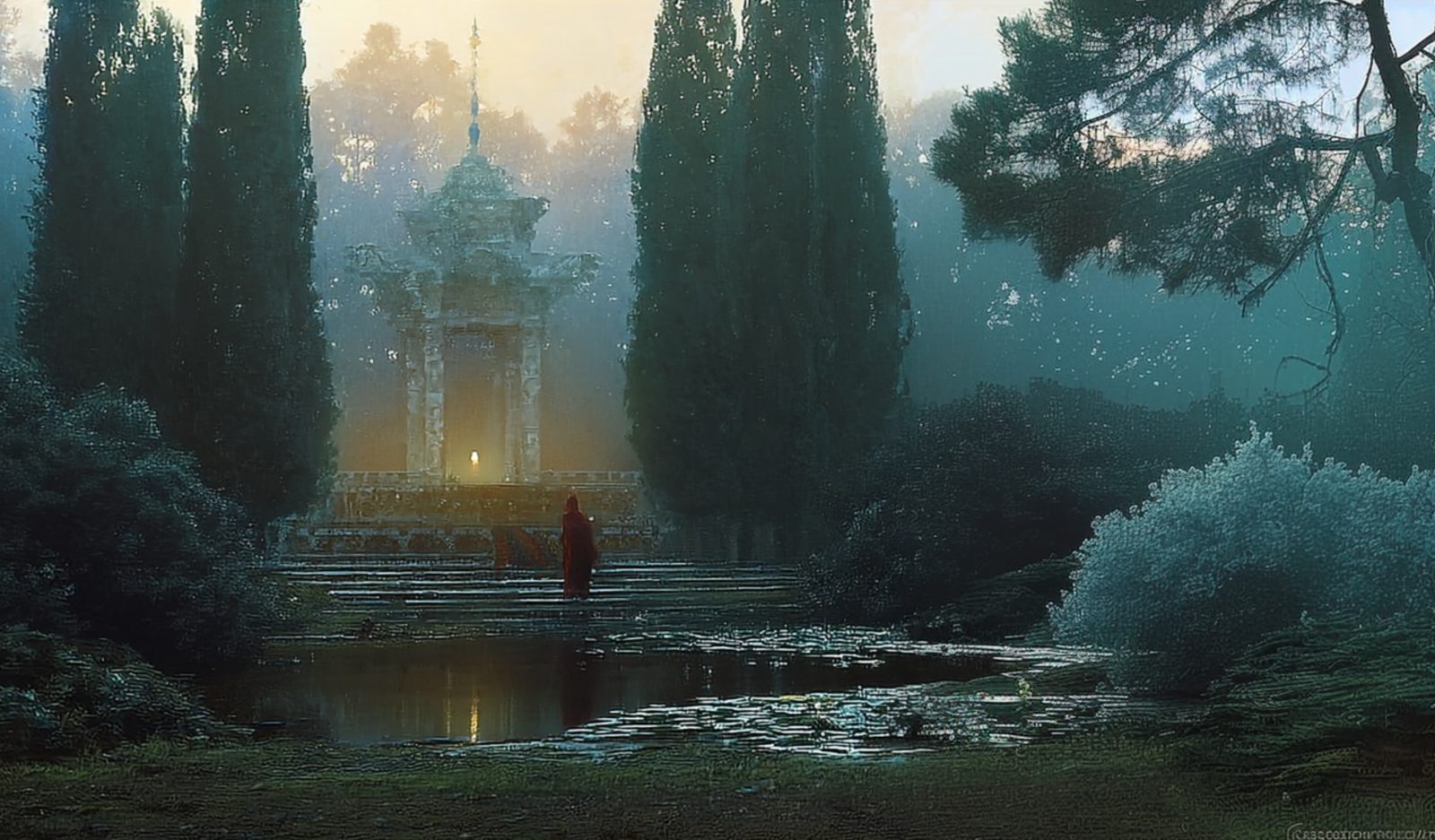
A tribe of fishermen, caught in a storm, stranded on the shores of Oneiro Island. An island where all species of plants, insects and animals flourish. Where rivers flow from the highest mountains to the most stretched lakes. Where the forests welcome all the concert of life. Where we hear the thrush like the wolf, sharing one and the same consideration: time. But by setting foot on the sands stretching out to the north of the island, this tribe will forever upset this harmony. The balance will be broken. This is the story of the fishermen of Calce. Of their dreams, of their glories, but also of the deep scars they will leave on Oneiro.

Species I
Species II
Species III
Species IV
Species V
Species VI

Fig. 07 · Flora of ONEIRO — species & relations

Fauna I
Fauna II
Fauna III
Fauna IV
Fauna V
Fauna VI

Fig. 08 · Fauna of ONEIRO — species & relations

Why Calces Exists

Calces is not a fictional world created for entertainment.

It is a laboratory of civilizational imagination.

Through cultures, myths, technologies and ecosystems, it explores how societies shape their relationship with the living world.

Its purpose is not prediction.
Its purpose is exploration.

Calces — the origins

The birth of a civilization on limestone shelves above a sea they do not sail.

The ages of Calces

The five ages of Calces are not historical periods.
They are investigations.

Each age explores a different relationship between human societies and the living world.

Each age behaves as a cinematic chapter — explanation, immersion, fragmentation, breathing.

Arrival on Oneiro Calce village

First age

  • amulets
  • combs
  • knives
  • masks
  • spears
  • primal huts
  • querns
  • ploughs

Expansion on the clearing

houseslightningharvest districtsscythesshovels
Discovery of the metal

Second age

  • Second age
Eccl drilling
Creation of Calces Creation of the first gigantic machine

Third age

  • first generation drilling machines
  • machines vessels
  • several generation drilling machines
  • ground digging machines
  • torpedoes
  • submarines
First Expansion War Calces-city Calces buildings
Acceleration Colonization

Fourth age

  • canonical fish
  • killing machines
  • killing and drilling shots
  • advertising machines
  • neon
End of Calces Wells
The Gas explosion

Fifth age

  • ink machines
  • harpoons
  • walking boats
The invention

Organic, primal, sacred. Ritual precedes instrument. The coast is liturgy.

Age I

The living world

Coexist · before sedentarization

How do civilizations belong?

A world of belonging.

For most of human history, people lived within the rhythms of the living world. Rivers, forests, animals and seasons were not resources but relationships. Culture emerged from participation in life rather than separation from it.

Age I · Coexist · The living world

At this stage, humanity does not seek to dominate the living world, but to belong within it.

Human societies live in direct relation with ecosystems. Forests, oceans, animals and territories are experienced as living presences rather than exploitable resources. Mythologies emerge from fascination, dependency and emotional attachment to the living world. The first tribes of Calces develop cultures deeply rooted in observation: the migration of fish, the movement of tides, the cycles of storms, the behavior of animals, the rhythm of seasons. Love becomes a civilizational force. Objects are not designed for accumulation, but for connection to memory, rituals, ecosystems and collective identity. Architectures remain temporary, adaptive and porous to environmental forces. Technologies evolve slowly, inseparable from ecological realities and oral traditions. Civilizations remain fragmented and tribal. Each biome develops unique rituals, symbolic systems and ways of inhabiting the Earth.

Sedentarization begins. Agriculture, domestication, hierarchy — the first distance from the living world, not yet its domination.

Age II

The first control

Cultivate · sedentarization

How do they begin to control?

The first rupture.

Humanity gradually began to place itself outside of nature. The living world became an object to measure, organize and transform. A new story emerged: one of mastery, extraction and progress through control.

Age II · Cultivate · The first control

Sedentary life

Agriculture & domestication

Cultivated land

Emerging hierarchies

Cold transition. Mythologies thin. Ritual becomes regulation; the body learns distance.

Age III

The separation

Loss of myth · rise of order

How do they separate?

The conquest of the Earth.

Industrialization multiplied human power beyond anything previously imaginable. Fossil energy, global production and technological systems reshaped the planet. But in transforming the world around us, we also weakened our connection to it — and, little by little, to ourselves.

Age III · Dominate · The separation

Industrial order

Extraction, propaganda, megacities. Visually overwhelming — control as atmosphere.

Age IV

Extraction

Kenaï era · hyper-control

How do they extract?

When the bill arrives.

The consequences of separation become impossible to ignore. Climate disruption, biodiversity collapse, extreme heat, resource depletion and growing instability reveal the limits of the extractive paradigm. Beyond ecological crises lies a deeper one: a cultural, moral and political impoverishment of our relationship with the living world.

Age IV · Control · Extraction

Not a return to the first age, but an invention. Rewilding, new rituals, harmony as effort — never as a state already reached.

Age V

The invention

Harmonize · fragile reconstruction

How might they reconnect?

Learning to belong again.

A new civilization begins to emerge. The living world becomes the center from which economies, technologies and cultures are designed. Innovation becomes a bridge rather than a weapon. Technology becomes a tool for reciprocity. Culture becomes a way of deepening our participation in life. The age of symbiosis begins.

The Fifth Age is not a return. It is an invention. A civilization learning once again how to inhabit the world while carrying the memory of everything that came before.

This is the age from which many Oneiro projects emerge.

Age V · Harmonize · The invention

New rituals

Humanity does not abandon its extraordinary capabilities; it redirects them.

What Emerges From Calces

A matrix is proven by what it gives birth to.
Calces is not an end.
It is a beginning.

Calces, the matrix, and its offspring CALCES the matrix Côme ages III to V Elaya age IV Symbiome age V Hymna age V Applied work age V
  • La Chance de Côme — from the ages of separation and rebuilding
  • Elaya — from the age of extraction
  • The Symbiome — from the fifth age, the bond rewoven
  • Hymna — from the fifth age, a brand-world of the living
  • Applied work — Mercedes, Rimowa, Delvaux, Jean Nouvel

CALCES · the matrix and its offspring · MMXXVI

From Calces emerge narratives, research frameworks and real-world applications. Each explores a different way of reconnecting human life with the living world.