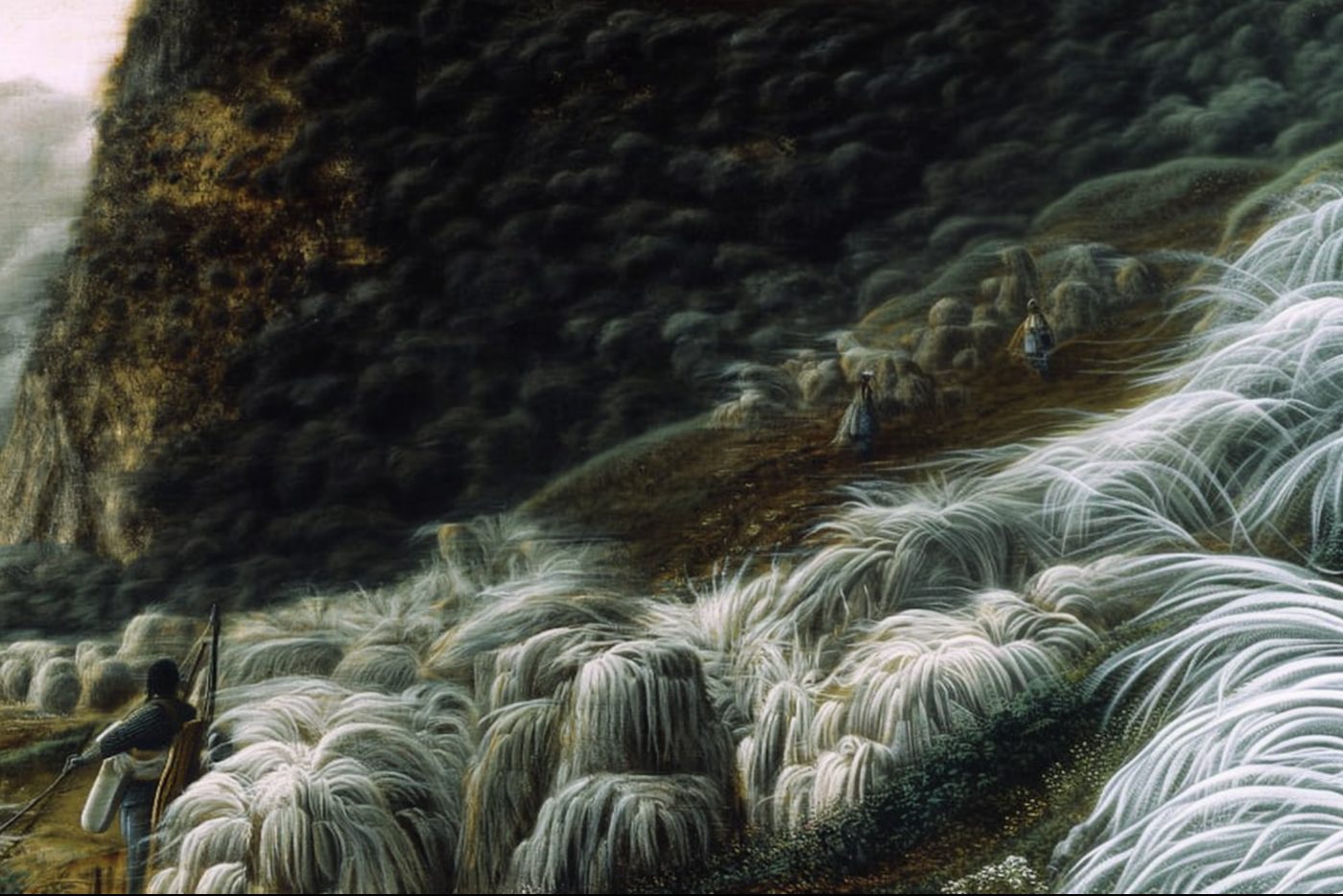
What happens when identity, production and ecology all emerge from the same living ecosystem?
Most brands that turn to the natural world use it as a source of inspiration. A landscape becomes a mood, a season becomes a palette. The territory furnishes images, but it remains external to the brand, which could have drawn its images from anywhere. Hymna proposes something stricter: here the territory is not a source of inspiration but the matrix itself, the ground from which the culture, the narratives, the objects, the materials, the rhythms and the forms all grow. Identity is not constructed. It is cultivated.
Hymna is not a brand inspired by nature. It is a cultural organism emerging from a long relationship between a community and a living ecosystem.
Plate I · a biome and the culture that grows from it
01 · Matrix
The biome as origin, not backdrop
When a territory is a backdrop, it can be exchanged for another without changing what the brand essentially is. When it is the matrix, it cannot be removed without the brand ceasing to exist. Everything Hymna produces follows from one ecosystem and the long relationship a community holds with it.
Because that relationship is specific, the identity it produces is specific too. It is not assembled from references chosen on the open market of style, but grown from conditions that belong to one place.
02 · Cosmology
A world, not a catalogue
A brand of this kind does not produce objects alone. It produces a way of seeing: a language and a poetry, a mythology and its figures, a set of symbols and a manner of inhabiting the world. The objects are only the most visible part of a far larger cultural body.
Each ecosystem yields its own version of this: its own vision of the living, its own sensibility, its own way of telling the seasons, its own cultural melody.
- A language
- A poetry
- A mythology
- Figures
- Narratives
- Symbols
- Ways of inhabiting the world
03 · Material
Matter tells a relationship
The materials matter for a reason beyond their being local. Locality alone is easily claimed and easily emptied of meaning. What Hymna asks of a material is that it be the result of an equilibrium: that it come from a living ecosystem, not from monoculture, industrial extraction or a sacrificed territory. A material that meets this condition carries an argument within it. It becomes proof, held in the hand, that another relationship with the living is possible.
04 · Economy
Rewilding made desirable
This is the most consequential idea of the project. Conservation usually arrives in the language of restraint: protect, limit, preserve. Hymna shifts the terms. Rather than asking a territory to be spared, it asks what a living territory can produce, and answers that it can produce beauty, culture, identity, value and, finally, an economy. In doing so it makes rewilding not merely permissible but desirable, both culturally and economically.
A living territory can produce beauty, culture and value without destroying the systems that make it possible.
05 · Independence
An identity outside the market
Most brands look for their identity in the market, calibrating themselves against trends and dominant codes. Their difference is a position taken within a field of other positions, renegotiated as the field moves.
Hymna looks for its identity in its territory instead. It follows the real seasons, the ecological cycles, the materials available, the slow transformations of the biome. Its difference is not the product of a strategy. It is the product of a relationship, and a relationship cannot be copied.
06 · Process
A living laboratory
Hymna is never finished, because the relationship it rests on is never finished. Each year brings new species and observations, new equilibria, new materials, new forms of coexistence.
It is better understood as a cultural organism in permanent apprenticeship than as a brand in the ordinary sense. A living laboratory, learning from the ecosystem it belongs to, and changing as that ecosystem changes.
Plate III · an identity dictated by real seasons
Hymna binds together Symbiome and rewilding, economy and culture, craft, material, narrative and identity, into a single coherent idea.